How parking brake works on disc brakes involves applying mechanical or electronic force to the brake system, engaging the caliper or drum-in-hat mechanism. This creates friction, holding the vehicle stationary independently of the main braking system.
Education on how a parking brake works on disc brakes is important for every car owner, especially those who own modern braking systems. A parking brake is more than a simple convenience; it is a vital safety feature designed to stop a car from rolling away when parked on a hill.
A car’s main braking systems use hydraulic pressure to slow a vehicle down, while a parking brake does not. It works detaches from the vehicle’s hydraulic system, using a variety of mechanical or electronic systems to lock the car in. This article goes over how a parking brake will work, specifically in cars that use disc brakes.
Contents
- 1 What is a Parking Brake?
- 2 Why Are Parking Brakes Important?
- 3 How the Parking Brake Operates on Disc Brakes
- 4 Types of Parking Brake Systems on Disc Brakes
- 5 Advantages of Parking Brakes on Disc Brakes
- 6 Fixing Parking Brake
- 7 Frequently Asked Questions
- 8 Final Thoughts
What is a Parking Brake?
The parking brake (also known as an emergency brake or handbrake) is an important part of a car’s safety features. The service brakes (the brakes used while driving) are different from the parking brakes. Service brakes can slow the car or stop it while it is in motion, whereas the parking brake is used only when the car is parked.
The parking brake needs to be used to make sure the vehicle does not roll away. This is especially important when parked on a hill or slope. This helps avoid accidents, or causing damage to the car.
Why Are Parking Brakes Important?
The parking brake is not a secondary feature. It’s an important safety mechanism that is designed to kick in if the primary brakes fail, or if the vehicle is going to be left in the parked position for a long period of time. The safety of a vehicle is dependent on the parking brake as much as it is on the primary braking system.
When it comes to disc brakes, the parking brake engages in a different way than how the system works when the brakes are used normally. This article explains how the parking brake works in conjunction with disc brakes, particularly the rear brakes, and how it helps to keep the vehicle safe.
How the Parking Brake Operates on Disc Brakes
In some vehicles with rear disc brakes, the parking brake disc systems utilize the different systems provided on the brake unit. The parking brake must be able to provide adequate pressure to the brake disc, while it is in the temporarily in the immobilized state, to prevent any motion
Most Important Parts That Constitute A Parking Brake System
The parking brake system is separate from the vehicle’s hydraulic braking system, so it is a system that is wholly mechanical, or in some cases, fully electronic.
A. Parking Brake Lever or Switch
The parking brake lever is situated between the driver’s seat and the center console (in some vehicles with a handbrake system). In more modern vehicles, the parking brake system is electronic, and the lever is replaced by a button, or in some cases, a foot pedal that is located near the driver’s feet.
When you activate the parking brake, you either pull a lever, step on a pedal, or push down on a button. This action sends a signal to the braking system, ultimately activating the parking brake.
B. Cables and Actuators
In older parking brake setups, when you pull the parking brake lever, it initiates a process that uses a steel cable to transmit that force to the brake system on the rear wheels. These cables are the rear brake components and when they are pulled or pushed, they lock up to create brake friction.
In today’s parking brake systems, especially those that use electronic parking brakes (EPB), the cables are replaced by electric motors or actuators that serve the same function. These actuators automatically lock or unlock the parking brake based on the driver’s command using the switch or button.
C. Caliper or Drum-in-Hat Mechanism
The caliper is vital to how the disc brakes function. In the rear disc brakes, the caliper has one piston that is pushed outward when the brakes are applied. This causes the brake pads to rub against the disc rotor, creating friction that slows the car down. However, when it comes to the parking brake, the caliper can be designed differently to allow for the parking mechanism to function differently.
- Caliper-integrated systems: Some disc brake calipers are designed to incorporate a mechanical actuator within the caliper. This can be in the form of a screw thread mechanism or a ball-and-ramp mechanism. When the parking brake is pulled, a lever or screw that is encased in the caliper moves outward, it pushes the piston out. This causes the brake pads to clamp down on the rotor, in turn keeping the vehicle in position.
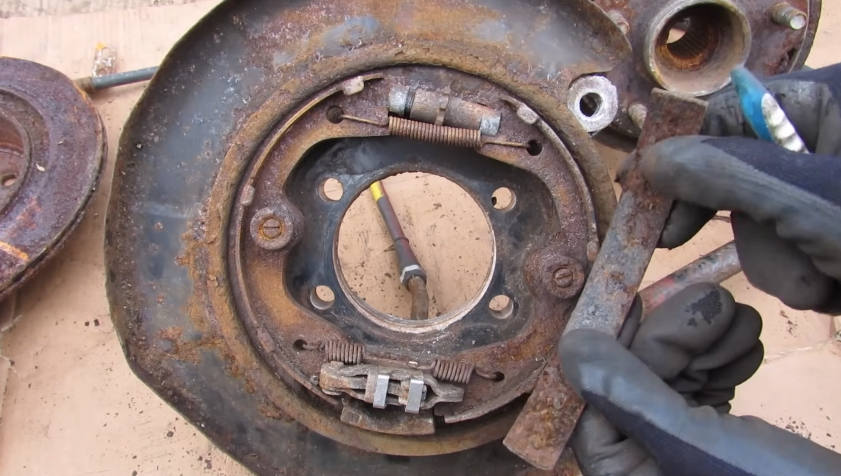
- Drum-in-Hat Systems: Some automobiles have a small drum brake built into the rear brake rotor’s hat section, located behind the rotor. This small drum brake uses brake shoes to make contact with the drum when the parking brake is pulled. This is also known as a drum-in-hat rotors parking brake. When the parking brake is applied, the shoes move outward to make contact with the drum to hold the car in position.
D. Brake Shoes and Pads
As you may know, brake pads or shoes create a resin-based friction material against a metal drum or rotor. When a parking brake is applied, one of these components push friction against either a rotor or drum, and create enough friction to keep the wheel immobile.
Step by Step Explanation of the Parking Brake Functionality on Disc Brakes
Now that we know which components are at play, we can create a step by step guide of the parking brake functionality on a vehicle that has disc brakes.
Step 1: Driver activates parking brake
When the driver pulls the parking brake lever, presses the foot brake pedal, or activates the electronic parking brake (EPB), a force is applied to the rear brake mechanism, which facilitates the engagement of the rear brakes. In the case of a mechanical EPB, this force is transmitted via cables, and in the case of an electronic parking brake, motors or actuators perform this function.
Step 2: Force is transmitted to brake mechanism
When the parking brake lever, pedal, or electronic button is pressed, a force is transmitted through the system to engage the brake components. This force either pulls a mechanical cable or activates an electric motor that in turn engages the brake mechanism on the rear wheels.
- Mechanical Systems: Pulling the cable operates a lever or actuator, which, in turn, triggers the caliper mechanism. This action moves the piston or activates the drum-in-hat system, which induces friction on the brake pads or shoes.
- Electronic Parking Brake (EPB): Once the EPB button or switch is engaged, the system utilizes a motor or actuator, which applies the parking brake. The motor drives a gear in the caliper or engages the drum-in-hat brake system, providing enough friction to keep the wheel locked in position.
Step 3: Brake Contact
When force is applied to the brake system, the brake pads either clamp down on the rotor (in the case of the caliper-integrated system), or the drum-in-hat mechanism pushes the brake shoes outward. This generates enough friction to lock the wheel.
Step 4: Vehicle Remains Stationary
The vehicle is now held in place by the brake pads friction against the rotor, or the brake shoes against the drum. This guarantees that the vehicle will stay parked, even on a slope or incline.
Step 5: Releasing the Parking Brake
To release the parking brake, the driver either pulls a release lever, presses the pedal again, or disengages the EPB button. This causes the cables or motors to retract, releasing the brake pads or shoes from contact with the rotor or drum. Now, the wheel is free to rotate again.
Types of Parking Brake Systems on Disc Brakes
When it comes to parking brake systems, vehicles today have a few different configurations. One of the more common systems consists of mechanical cables, while the second would be electronic parking brake systems (EPB).
Mechanical Cable Parking Brakes
This is the original system, and has been used for a long time in vehicles. There is a cable that runs from the parking brake, which can be a pull lever or a foot pedal, to the rear axle brake system. When the brake is pulled, the cable transfers the braking action to the caliper or the other components in the drum-in-hat system.
This system is still used today in vehicles because of their simplicity, cost and reliability. On the downside, the system is not ‘set and forget’ as quite a bit of manual adjusting and maintenance is required to keep the cables from dragging and to have the brake shoes or pads engage.
Electronic Parking Brakes (EPB)
In today’s vehicles, more and more electronic parking brakes (EPB) are being used, especially in the upper tier ranges. In these systems, the cables are replaced with small motors or actuators. When the driver engages the parking brake using a switch or button, the system sends a signal to the motor which in turn applies the parking brake.
EPBs are easy to use, activate automatically, and provide efficient use of cabin space. Features included in these systems are hill hold, which activates the parking brake when the vehicle is on an incline, and auto-release, which disengages the parking brake when the vehicle begins moving.
Advantages of Parking Brakes on Disc Brakes
An unblemished parking brake system on a car equipped with disc brakes is favorable in a number of ways.
Redundant Safety Feature: The parking brake can also be considered as part of the redundant safety features integrated into the cars. With the parking brakes, the vehicle can still be held in place when the primary braking system fails.
Prevents Rollaway: One of the main and most critical functions of the parking brakes is to ensure that the vehicle does not roll away when it’s parked. This is of utmost importance when the vehicle is parked on a slope or an incline.
Protects Transmission: Engaging the parking brake relieves the stress on the vehicle’s transmission. When a car is left in the ‘Park’ mode without also engaging the parking brake, the transmission’s parking pawl is subject to stress. Engaging the parking brake reduces this stress, preventing transmission damage.
Fixing Parking Brake
To keep your parking brake system running smoothly, you might want to consider parking brake system maintenance. Some techniques for parking brake maintenance include:
- Check for any fraying or breaking in the cables.
- To ensure the cables don’t rust and work smoothly, lubricate them.
- When brake pads or shoes are worn out, make sure to replace them.
- To make sure the parking brake is working correctly, make sure to test it regularly. This is especially important to ensure that the parking brake is working correctly on big hills.
Frequently Asked Questions
Here are some FAQs about how parking brake works on disc brakes –
1. Why do you need to use the parking brake every time you park?
Applying the parking brake keeps the transmission from being overworked. It also means the vehicle will not move, especially important on hills.
2. How can I tell if the parking brake needs to be readjusted?
If the parking brake lever feels loose, or the vehicle rolls when the brake is pulled, the brake might need to be readjusted. It is a good idea to check it every so often.
3. Is it true that the parking brake can be used in emergencies?
In an emergency, you can use the parking brake to stop the vehicle, but use caution. If not done slowly, the wheels could lock up.
4. Do electronic parking brakes need different care than mechanical parking brakes?
Yes, electronic parking brakes (EPBs) need care that mechanical parking brakes don’t need. Regular brake checks on EPBs need something extra. You need to do electronic system checks to make sure the actuator or motor is working.
5. Can a parking brake fail?
Yes, like any mechanical system, parking brakes can fail. If not properly maintained mechanical components such as cables, shoes, or electronics can lead to brake failure.
Final Thoughts
The parking brake is an important safety feature. It is responsible for keeping your vehicle in the same spot when it is parked. When understanding how a parking brake works on brake discs, it helps you look at the mechanics more closely. It doesn’t matter if your car has an electronic parking brake or if it has a mechanical cable system. The most important part is the same. It is to keep your vehicle in place whenever you want.
The parking brake system must be maintained in order to ensure that the car can safely operated. It is important to understand how parking brake systems function in order to keep a vehicle protected and secured at all times.