How to tighten parking brake: To tighten your parking brake, locate the adjustment nut on the cable and tighten it until the brake lever engages with 3-6 clicks, ensuring the brake holds securely.
When your parking brake is not holding your car securely when parked. it is time to tighten it. a parking brake not holding your car can cause frustration and is a major safety issue. There are methods to adjust your parking brake at home without the need for a service professional. An adjustment of your parking brake can be done for a fairly low cost. An adjustment would result to your car being secured when parked.
This is a guide to tightening your parking brake, and includes the necessary tools, a step by step guide, troubleshooting, and some tips for maintaining your parking brake system.
Contents
- 1 What is a Parking Brake and Why is it Important?
- 2 How to Tighten Parking Brake
- 2.1 Tools You’ll Need
- 2.2 Step 1: Assess the Parking Brake’s Effectiveness
- 2.3 Step 2: Raise the Vehicle (When Needed)
- 2.4 Step 3: Identifying the Mechanism for Adjusting the Parking Brake
- 2.5 Step 4: Modify the Parking Brake Cable
- 2.6 Step 5: Testing the Adjustment
- 2.7 Step 6: Lower the Vehicle and Recheck
- 3 Problems Parking Brakes Have
- 4 How to Tighten an Electronic Parking Brake (EPB)
- 5 Frequently Asked Questions
- 6 Conclusion
What is a Parking Brake and Why is it Important?
One of the components of your vehicle that is the most critical to the safety of the vehicle is the parking brake. The parking brake is often referred to as: the emergency brake, the hand brake, or the e-brake. The parking brake is an additional system that works to secure the car when parked.
The primary purpose of the parking brake is to ensure the back tires of the car are locked so that the car is not able to roll away. This is especially important when parked on a hill or when a car is idling in gear.
In most vehicles, a parking brake can is activated by a hand lever in between the front seats, or by a pedal near the driver. Like any other part of the car, the parking brake can get worn out or misaligned, which increases the likelihood of the brake losing effectiveness. This may mean you need to adjust the parking brake to keep it functional.
How to Tighten Parking Brake
Before you start any work on the parking brake, it is vital to get familiar with the brake components. There are two primary types of parking brake systems – cable-operated systems and electronic systems. We will start with cable-operated systems.
Tools You’ll Need
Adjusting the parking brake requires only a few tools –
- A wrench or socket set will enable you to adjust the parking brake cable.
- A jack and jack stands will be needed if you need to raise the vehicle to access the rear brakes.
- A screwdriver will be needed to remove any interior panels or covers.
- If you want to keep your hands clean while you work with the brake components, you can use a pair of gloves.
Step 1: Assess the Parking Brake’s Effectiveness
Before you do any work on the parking brake, it is important to assess how loose the parking brake actually is, which can be achieved by performing a simple test.
Engage the parking brake lever: You will need to pull the hand brake lever to perform the test. Watch how many clicks the lever makes. It should take 3-6 clicks to fully engage the brake. More than that and the brake might need to be tightened.
Check how well the brake works: Find a place where the road slopes down. Set the parking brake and see if the car rolls. If it does roll, the parking brake needs to be adjusted.
Step 2: Raise the Vehicle (When Needed)
If your car’s parking brake is a simple mechanical system (cable-operated), it is necessary to raise the back of the car to get to the brake parts. Here’s how to lift your car safely:
Park your car on a flat surface: Make sure your car is parked on a flat surface. Before you start, double check that your car is on a flat and steady surface.
Use a jack to raise the car: Place the jack under the back axle and raise the car until the back tires are off the ground.
Add jack stands for safety: Once you have lifted the car, add jack stands under the car to hold it. You should never depend only on the jack to hold the car up.
Tip: If you don’t know how to position the jack, check your car’s owner’s manual for proper jacking points.
Step 3: Identifying the Mechanism for Adjusting the Parking Brake
With the vehicle lifted, you can now begin adjusting the parking brake. Depending on the construction of the car, the parking brake adjustment may be located in different areas, but it is primarily found toward the rear brake assembly.
For Cable Operated Brakes:
Cable operated parking brakes engage the brake shoes on the rear wheels using cables. Adjusting the parking brakes can be done at the following locations:
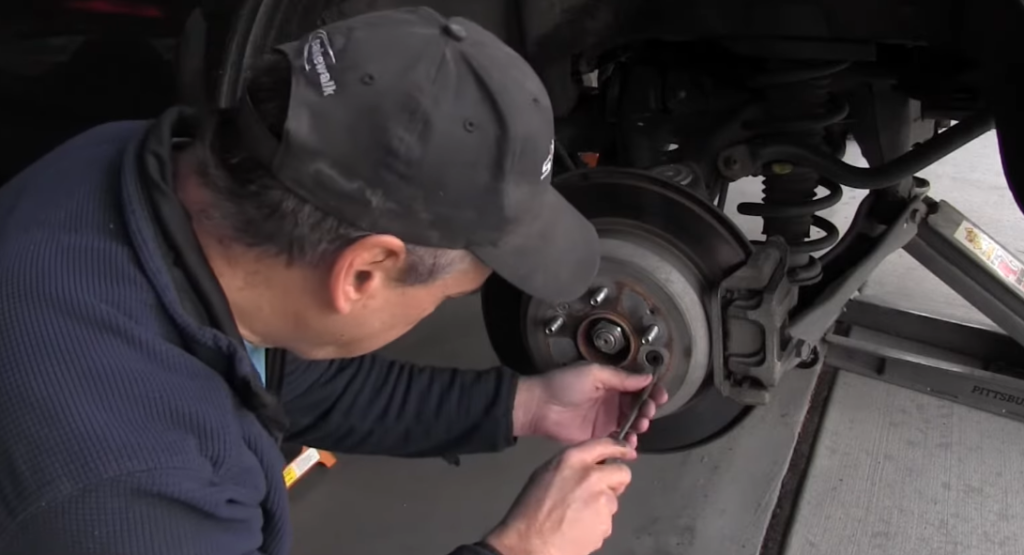
- Rear Brake Assembly: For the drum brakes, adjustments can be made at the brake drum, while for the disc brakes, adjustments can be made at the brake caliper. With both assemblies, the adjustment mechanism can be either a star-wheel adjuster or a screw mechanism, either of which can tighten or loosen the brake cable.
- Center Console (if it exists): The adjustment mechanism may be located under the vehicle toward the rear axle, but it may also be near the handbrake lever. There may also be a nut or bolt that can be tightened under the center console to reduce the length of the parking brake cable.
For Electronic Parking Brake:
Modern cars with electronic parking brakes (EPB) use a combination of motors and sensors for brake engagement. Adjusting the EPB is a complicated process that requires special tools.
Utilizing a diagnostic device or scan tool may be needed for a possible reset or recalibration of the brake system. If you have an EPB, it is always recommended to consult a professional mechanic or your vehicle’s manual.
Step 4: Modify the Parking Brake Cable
If the automobile is fitted with a cable-operated parking brake, the following step is to tighten the parking cable. This is how to do it.
1. Locate the adjustment nut: Most vehicles have an adjustment nut or a bolt somewhere along the parking brake cable. You can find this under the vehicle or beneath the center console.
2. Tighten: Adjust the gap by turning the nut or bolt. Using a wrench or socket, tighten to reduce the slack. Make sure to only tighten it to the point where the parking brake engages automatically. Making it too tight is bad, as it can cause premature wear to the parking brake.
3. Check the brake lever: After tightening the cable, pull the parking brake lever again. It should take 3 to 6 clicks to fully engage. If it still feels too loose, you need to do some more adjustments.
Step 5: Testing the Adjustment
Let’s get on to the fun part: Testing adjustments. Parking brakes usually take 1 to 3 clicks to fully engage. Test by pulling the lever and counting the clicks. You want it to take 3-6 clicks to be fully set.
Now, for the real-world test. Get onto a small incline and engage the parking brake. The car shouldn’t move. If it holds, the adjustments are done.
Step 6: Lower the Vehicle and Recheck
Once you’re satisfied with the adjustments you made, let’s wrap up the steps:
Let the car down: Use the jack to carefully lower the vehicle. If you haven’t already, make sure to take the jack stands and lower the vehicle all the way to the ground.
Give it one last brake test: Make sure to test the parking brake one last time. Engage the brake to make sure the car does not move.
Problems Parking Brakes Have
Even though you take great care for your brake, it could still develop some problems. By knowing the common problems, you could diagnose and fix them quickly. This will keep your car safe and secure when parked.
1. Loose Parking Brake: A common problem that needs adjustment is your parking brake being too loose. The parking brake cable that holds the brake gets loose due to wear and tear. The parking brake cable just needs to be adjusted to fix the problem.
2. Sticking Parking Brake: If the parking brake does not release with the lever, the problem may be with the cable. The cable may need to be cleaned, lubricated, or replaced, and there may be dirt and rust to be cleaned.
3. Noisy Parking Brake: If the parking brake or parking lever is squeaking, it may be due to the brake shoes or brake pads that may need replacing. The pads will need to replaced to fix this problem.
4. Inconsistent Holding Power: If the parking brake is not doing its job and allowing the car to roll, there may be an issue with the brake shoes, pads, or cables that could be the source of the problem. These components may need to be replaced.
How to Tighten an Electronic Parking Brake (EPB)
In recent years, the use of Electronic Parking Brakes (EPB) have gained substantial popularity. These brakes are different from the rest because they use a cable that is controlled with a motor instead of a mechanical cable. A scan tool or other diagnostic tool is typically necessary to adjust an EPB system.
Vehicle’s manual: Depending on the make and model, cars can vary greatly on how to make adjustments to the Electronic Parking Brake (EPB). Always consult the manual before doing any adjustments to the EPB.
Use a scan tool: They can be utilized to access EPB systems and calibrate the motorized brake.
Take it to the pros: If you aren’t feeling super confident using the diag equipment call a mechanic to check the system.
Frequently Asked Questions
Here are some FAQs about how to tighten parking brake –
How can I tell if my parking brake is too loose?
If it seems like using the parking brake is too easy- your parking brake may be too loose. If the lever seems to pull up more than six clicks before engage, or If your vehicle moves while even a little downhill, that feedback indicates a loose brake system.
Do I need to lift my car to adjust the parking brake?
Cars with cable-operated parking brakes typically need to be lifted to access the brake components. Electronic parking brakes, on the other hand, usually do not need the car to be lifted.
Why is my parking brake not holding my car on an incline?
It can be due to a broken brake pad, worn brake shoes, or a loose parking brake cable. In the above scenario, it is fine to resolve the problem by replacing the brake pads or tightening the cable.
Can I adjust an electronic parking brake myself?
Most likely, you will need a repair manual or a mechanic because adjusting an electronic parking brake is almost always going to need a special diagnostic tool.
How often should I check my parking brake?
Check the effectiveness of the parking brake every 6 months. If you notice that it is becoming less effective, check the brakes sooner. Regular maintenance is needed to keep the car secure and to prevent any future issues.
Conclusion
Parking brakes can be a pain, however, the safety of your vehicle and those around you depends on a properly adjusted parking brake. Following proper regulations and as described in this guide, you can trim the parking brake by yourself. In case your setup has an Electronic Parking Brake, it is even more critical to check that your system is in good working order to ensure that the parking brake is operational and reliable.