


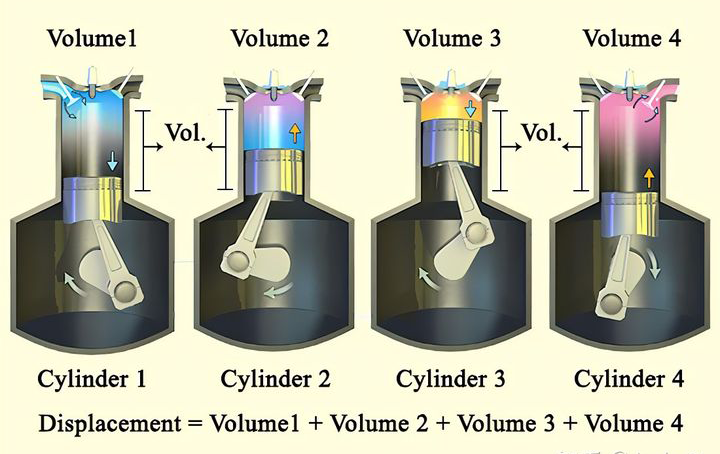
Engine displacement is the total volume of all engine cylinders, usually measured in liters (L) or cubic centimeters (cc). Larger displacement typically means more power, but other factors also affect engine performance.
When dissecting how an engine functions, usually the first specification available is engine displacement. It also helps provide an estimate of what the engine can accomplish in relation to the vehicle’s power, torque, and general performance. Engine displacement is defined as the total volume contained in the engine’s cylinders and also include the total air and fuel mixture that can be used for combustion. Knowledge of engine displacement is important for a better understanding of how an engine functions and for a better understanding when engine sizes are compared in different makes and models of vehicles.
This article explains engine displacement and how it is calculated. It also provides an explanation for why it is important, what it’s relation to engine performance is, and how it affects fuel consumption.

Contents
- 1 What is Engine Displacement?
- 2 Why Displacement Matters
- 3 Units of Measurement for Engine Displacement
- 4 Why Engine Displacement Affects Performance
- 5 Various Types of Engine Designs and Engine Displacement
- 6 Engine Displacement and Performance
- 7 Myths About Engine Displacement
- 8 Frequently Asked Questions
- 9 Conclusion
What is Engine Displacement?
Engine displacement is the measurement of the total volume of an engine’s cylinders. This is measured within an internal combustion engine in either liters (L) or cubic centimeters (cc). Engine displacement measures how much space is in the engine cylinders that the pistons move from top to bottom. More engine cycles mean greater engine displacement which means greater amounts of air and fuel that can be processed. This typically can be higher power output.
How Engine Displacement Is Calculated
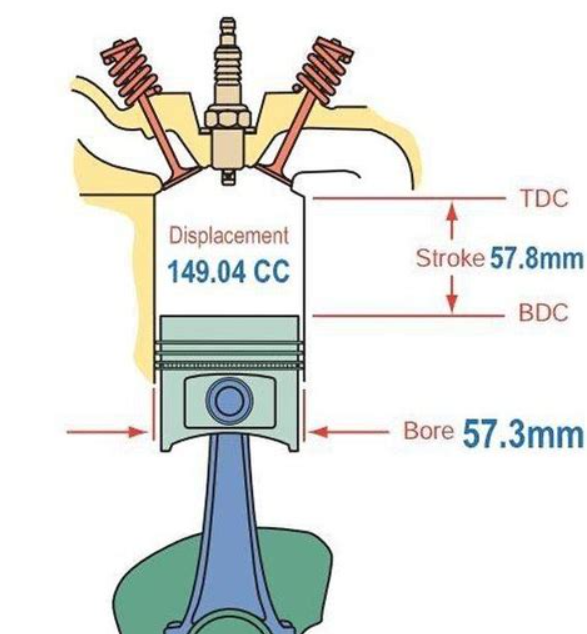
Engine displacement is calculated using three main components:
- Bore – the diameter of each cylinder.
- Stroke – the distance a piston travels from its lowest to its highest point inside the cylinder.
- Number of Cylinders – the total number of cylinders in the engine.
To calculate displacement, the formula is:
Displacement = (π / 4) × Bore² × Stroke × Number of cylinders
This formula takes into account the size of one cylinder (bore and stroke) and then multiplies it by the number of cylinders in the engine. The result is the total volume of the engine in cubic centimeters (cc) or liters (L). If you need to convert cubic centimeters to liters, simply divide the result by 1,000.
For example, if you have an engine with a bore of 85 mm (0.085 meters) and a stroke of 88 mm (0.088 meters), and the engine has 4 cylinders, the calculation would be as follows:
- Bore = 85 mm
- Stroke = 88 mm
- Number of cylinders = 4
Displacement = (π / 4) × (0.085)² × 0.088 × 4 = 1.77L or 1,769 cc.
The displacement is often rounded for convenience, and this engine would be described as having a 1.8L displacement.
Why Displacement Matters
Getting an understanding of an engine’s possible power output would involve getting an idea of its displacement. Displacement provides an idea of how much fuel and air an engine can burn each cycle. Thus, larger engines are built for stronger performance as a larger amount of air and fuel can be combusted and turned into power.
However, combusting more air and fuel each cycle does not mean an engine will be more powerful or more efficient. Displacement does not help you understand an engine’s efficiency or how powerful it will be.
Units of Measurement for Engine Displacement
Displacement can be measured and expressed differently depending on the region or the size of the engine. Most of the time, they are expressed in:
- Cubic centimeters (cc): This is mostly used in smaller engines and motorcycles.
- Liters (L): This is used in larger engines and in virtually all passenger vehicles.
- Cubic inches (ci): This is used in some older American vehicles.
Let’s take a look at how car engines are divided. For instance, a car with a 2.0L engine has a total displacement of 2,000 cubic centimeters (cc). If a car has a 5.0L engine, it has 5,000 cc of total swept volume. Some older American cars, however, had their displacement measured in cubic inches. For example, a 350ci engine.
Why Engine Displacement Affects Performance
Displacement is a vital factor in the performance of a car, especially in aspects like power, torque, and acceleration. Generally, a bigger displacement allows the engine to burn a greater volume of the fuel and air mixture and therefore improves the power of the engine. However, displacement is not the only characteristic that dictates the performance of an engine.
1. Power and Torque
In the performance of an engine, displacement has got to do with the power and torque produced by the engine. Power and torque are the two most important parameters that determine engine performance.
Torque is the rotational force produced by the engine. It is the reason a car is able to accelerate, especially when starting off from a standstill.
Horsepower measures the rate at which an engine produces torque. It is the reason an engine is able to sustain high speeds and is a major indicator of the engine’s performance at high speeds.
Larger engines are designed to create more torque at lower rpm (engine revolutions per minute), which can improve performance when starting from a standstill or when they need to pull heavy loads.
2. Fuel Consumption
However, larger engines tend to consume more fuel than smaller engines. Because larger engines have a bigger volume to fill, they need more fuel to process the volume because more air needs to be mixed with the fuel. That being said, larger engines can add efficiency in certain driving situations. For instance, larger engines might waste more fuel in heavy traffic, but can be more economical than smaller engines by using less fuel at higher speeds on the open road.
Smaller engines tend to be more fuel-efficient than larger engines in stop-and-go traffic situations, but when a lot of power is needed, such as in high-speed situations or when doing heavy tasks, they tend to lack the needed power. Because of this, more and more automobile manufacturers are utilizing fuel efficiency technologies such as turbocharging and supercharging to increase the efficiency of smaller engines. These technologies allow smaller engines to operate in a more fuel-efficient manner without having to increase the size of the engine.
3. Emission and Regulation
Some areas can categorize or charge a vehicle different fees and taxes based on the size of the vehicle’s engine displacement. The size of the engine can be linked to greater fuel use because of that and consequently, they can be subjected to greater fuel emission laws and greater greenhouse gas emissions. As a result, some countries or areas introduce tax policies to charge greater taxes on vehicles with engine displacements of large size so that fuel use and pollution can be controlled at a sustainable rate.
In this past couple of years, there has also been a focus on smaller engine sizes and engine downsizing. This is because automobile makers have to balance creating efficient environmentally sustainable vehicles and powerful vehicles. And so, some of the most common alternate methods to reduce the negative environmental effects of large scaled engines are the use of turbocharging, hybrid engines, and engines that use other forms of fuel.

Various Types of Engine Designs and Engine Displacement
Engine design can play a massive role in determining the engine’s displacement and the performance of the engine itself. Multiple designs include Inline design, V-design, and Wankel engines. Each of these designs has its unique benefits such as the delivery of power, the amount of space the engine consumes, and the overall efficiency of the engine.
Inline Engines
Inline engines have a unique design that has all the engine’s cylinders in a single straight line, and not all of the cylinders have to be the same number, and can be either odd or even. This type of engine is one of the simplest to both design and balance which is one of the benefits of inline engines. Because they are considered to be less complicated, they are usually less costly to manufacture.
Because of these reasons inline engines tend to be used more in smaller cars to decrease the overall cost of the vehicle. The engine displacement in an inline engine can be calculated by adding the volume of all the engine’s cylinders and multiplying that by the amount of cylinders in the engine.
V-Engines
In a V-engine, a cylinder arrangement forms a V as two banks sit angled apart from a side view. The arrangement allows for a more compact engine, accommodating a more significant number of cylinders, which improves power distribution. As a result, the V configuration is more powerful than the inline configuration of the same engine. V-engines are common in large vehicles, including trucks, sports cars, and luxury sedans.
Wankel Rotary Engines
Instead of pistons, the Wankel engine uses a triangular rotor that spins in an oval chamber, which allows for a smaller and lighter design. However, Wankel engines are less fuel-efficient and have greater emissions, meaning Wankel engines are more harmful to the environment. Unlike traditional engines, Wankel engines measure engine displacement based on the rotor and is measured differently to account for the lower weight in smaller combustion chambers.
Engine Displacement and Performance
Engine displacement is a more significant measure in a vehicle’s performance, including the power, torque, and acceleration, than the vehicle’s design, engine technology, or engine tuning. Engine displacement is the most measureable factor that directly impacts performance and is most often affected more than other elements.
Acceleration
Bigger engines often mean better acceleration – especially when you stomp on the pedal at low speeds. This is because the engine produces more torque. Torque is a rotational force, and with more force turning the wheels besides the engine already turning them, you can expect faster acceleration. However, smaller engines have started to be able to nearly match acceleration thrugh turbocharging/high pressure exhaust system with on board power generator like devices to force exhaust to spin a power generator to trot out tough to make power.
Top Speed
Top speed is determined more by the power of the engine rather than the size of the engine. Even when a car is equipped with a smaller engine, it can be made to go very fast with smaller engine than most. This is because the size, shape, and weight of the car can be altered to make it more aerodynamic and the road wheels can be geared higher to be able to spend faster at high speeds, allowing the car to reach much higher speeds than one would expect.
Myths About Engine Displacement
Many misconceptions exist about engine displacement and engine efficiency. Displacement is often important, but it does not mean a better engine as advanced engineering and design of engines can make more power and better fuel usage than bigger engines engines with less displacement.
Displacement Equals Power?
An engine’s displacement doesn’t always reflect an engine’s performance. A good engine design (turbocharging, fuel delivery system) can all be major power gains. With good design, smaller engines can have a massive advantage over bigger, naturally aspirated engines.
Engine Size Alone Tells Everything?
Displacement doesn’t tell the engine’s performance story. Modern engines have many techniques (variable valve timing, fuel injection, turbocharging) that can improve power and efficiency.
Frequently Asked Questions
Here are some FAQs about the engine displacement –
1. Is it true that increased engine displacement always results in greater power output?
In most cases, yes, larger engines are capable of providing more power, but other factors such as design, fuel delivery systems, and even forced induction systems can influence engine power output greatly.
What is the relationship between engine displacement and fuel efficiency?
In general, larger displacement engines use more fuel, and in city driving, this is true for all sizes of engines. However, smaller engines (especially those using turbo) can be more fuel efficient.
Is it possible to change engine displacement?
Yes, it is possible, but it rarely should be done unless you are performing significant upgrades to the engine and is often more trouble than it is worth.
Conclusion
What is engine displacement is an important question when considering a vehicle’s performance. Engine displacement is a metric that shows the total volume of a vehicle’s engine cylinders. It measures how much air and fuel an engine can process. Larger engines provide more power, torque, and sacrifices the fuel efficiency. Modern technologies (turbocharging, hybrid system) have allowed smaller engines to perform at a higher level. With that said, modern technology engines provide a smaller fuel process and greater overall performance. When considering an engine’s performance, displacement is one of the many important factors.


