A horizontally opposed boxer engine has cylinders arranged flat and opposing each other. This design reduces vibrations, improves balance, and lowers the vehicle’s center of gravity for better handling.
The horizontally opposed boxer engine holds a special place in the heart of many auto enthusiasts, engineers, and builders. It’s a different internal combustion engine that has a variety of unique attributes. With features such as low vibrations, better balance, and a lower center of gravity, it has many advantages. Despite frequent use of inline and V engines, it offers most of the same advantages, design wise.
We will discuss the history, mechanics, pros and cons, and difficulties of the horizontally opposed boxer engine in this text. Finally, we will examine the configurations of this engine and the reason it still serves particular functions.
Contents
- 1 What Is a Horizontally Opposed Boxer Engine?
- 2 History of the Horizontally Opposed Boxer Engine
- 3 What is the Mechanism of a Horizontally Opposed Boxer Engine?
- 4 Benefits of Given Horizontally Opposed Boxer Engine
- 5 Drawbacks of a Horizontally Opposed Boxer Engine
- 6 Uses of Horizontally Opposed Boxer Engine
- 7 Performance and Driving Dynamics
- 8 Frequently Asked Questions
- 9 Conclusion
What Is a Horizontally Opposed Boxer Engine?
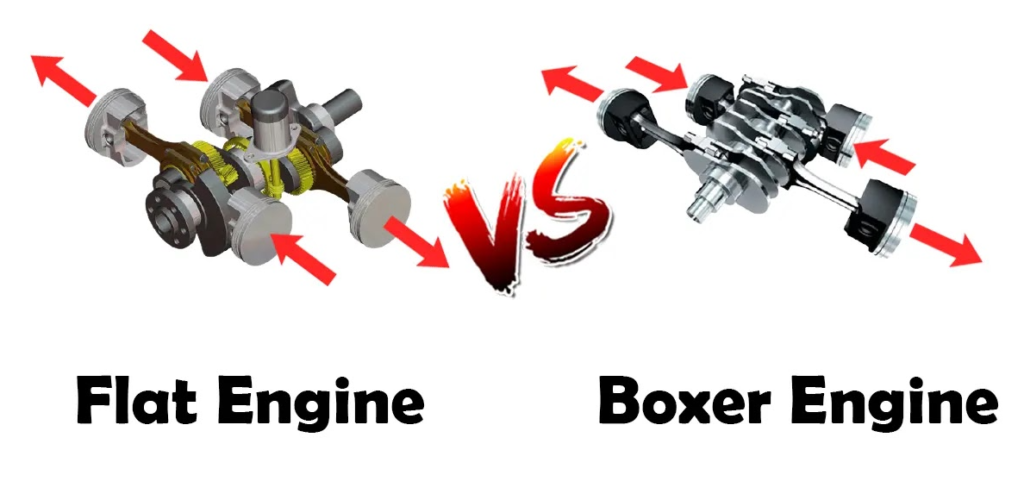
A horizontally opposed boxer engine engine is a specific type of a flat engine. In this case, the cylinders are set in 2 banks and are against each other. These are positioned horizontally along the center of the engine’s crankshaft. An important feature of the boxer engine is the piston moves. When a piston moves crankshaft, the opposing piston moves out. It’s a boxing movement, and this is the reason it earned that name.
Boxer engines are a special type of automotive engine distinguished from other engine framings by a number of key features:
- Flat layout: engines have a wide but low profile.
- Opposing pistons: pistons in each bank face each other and move in opposite directions to help with balance and vibration.
- Low center of gravity: due to a flat engine configuration, a car’s center of gravity is lowered to help with handling.
- Inherent balance: the opposite piston motion cancels much of the engine’s natural vibration to create a smoother engine operation.
History of the Horizontally Opposed Boxer Engine
The horizontally opposed boxer engine is a mechanical concept that is over a century old, but was not able to be commercialized until the 20th century due to the engineering challenges of the time.
Early development of the Horizontally Opposed Boxer engine
Karl Benz’s flat engine: This is the earliest engine in horizontal development from 1897. It was created for experimental purposes and was not commercially adopted. This engine was a precursor for all other advances in this area.
First Use in Aircraft: The horizontally positioned engine has a unique history. It balances the positive and negative forces of the four inline cylinders. The rear-mounted horizontal engine extends the quad outward. This design makes it ideal for float planes and airplanes.
The Rise of Boxer Engines:
Volkswagen and Porsche: The widespread use of the horizontal engine occurred in the 1930’s with the start of the Volkswagen Beetle with a flat four boxer engine. Porsche followed with the flat six boxer engine on the 911, and that engine configuration became a hallmark of Porsche, and still today, they continue to use boxer engines.
Subaru: In the 1960’s Subaru also adopted the boxer engine in many of its cars, especially in the all wheel drive ones, and Subaru has also continued to use the boxer engine in many of its cars because of the engine’s low center of gravity and the overall smooth and balanced operation.
Ongoing Usage in Performance and Specialized Contexts
Even though the horizontally opposed boxer engine is unusual in the mass automotive industry, it is still utilized in some high-performance models. Porsche still has flat-six engines in the Porsche 911, and Subaru has flat-four engines in Impreza and Outback models. Additionally, boxer engines can be found in some motorcycles (like BMW’s “boxer” engine motorcycles”) and in airplane engines from Lycoming and Continental.
What is the Mechanism of a Horizontally Opposed Boxer Engine?
Like any other internal combustion engine, the horizontally opposed boxer engine has a distinct feature. Its cylinders are horizontally opposed. Here is a breakdown of the workings of the explained engine.
1. Cylinder Layout and Operation
In a boxer engine, you can find the cylinders arranged in two sets with each of the sets positioned opposite to one another relative to the crankshaft. One piston operates in the opposite direction of the piston in the other cylinder bank. When one piston is moving in (toward the crankshaft), the other is moving out, and this crossed movement helps in balancing the combustion force (which is generated during combustion), thereby reducing vibrations.
2. Crankshaft and Piston Motion
Each crankshaft in a boxer engine is linked with a crank pin on every piston. As the crankshaft rotates, it shifts the power generated by combustion into the vehicle’s drivetrain, which balances out the engine because the forces of the two opposing pistons negate each other.
3. Combustion Cycle
The combustion of the boxer engine is the same as in any other internal combustion engines:
- Intake: Combustion starts with the intake valve’s opening, which allows the fuel and air to enter the combustion chamber.
- Compression: The fuel and air mixture is compressed by the upward moving piston.
- Ignition: The mixture, which is now a compressed gas, is set off by a spark from the spark plug. This event causes a mini explosion which drives the piston downward..
- Exhaust: The piston then rises to push out the gases of combustion and leaves the chamber ready for the next cycle.
This cycle is repeated by each piston, which works with the other fuel and air mixture pistons to create a balanced and smoother engine.
Benefits of Given Horizontally Opposed Boxer Engine
The horizontally opposed boxer engine has a range of benefits that makes it popular over other engine types in some specific use cases like performance and all-wheel-drive cars.
1. Less Engine Vibration
The most significant benefit of the boxer engine is that it has a unique design that reduces engine vibrations. The pistons on a boxer engine are able to cancel out vibrations when they cause an opposing force to another piston. This makes the engine feel much smoother and allows it to operate without the need of a costly balance shaft like other engine types need to manage engine vibrations.
2. Improved Vehicle Center of Gravity
Compared to other types of vertical inline engine designs, horizontally opposed boxer engines improve vehicle center of gravity. This allows for better vehicle handling and overall vehicle stability. This is especially important in sports performance cars like the Porsche 911.
3. Better Handling
The overall balance of a vehicle improves with a lower-mounted engine in the chassis. The vehicle’s responsiveness and stability increase with a lower center of gravity because there is less body roll during sharp turns. For this reason, Subaru’s Outback and WRX and other all-wheel drive vehicles prefer boxer engines to improve stability in challenging driving situations.
4. Built-in Engine Balance
The opposed design doesn’t just cut down on vibration, it’s also a means of eliminating the unbalanced forces produced during operation of the engine, resulting in less wear on parts and a longer engine life. Engine components are easier to manage and maintain because of the engine’s symmetry.
5. Space Efficiency
The boxer engine is indeed wide, however, it’s shorter in the other dimension, which aids in the overall compactness. This is particularly advantageous in tight spaces, like in the engine bays of sports cars or in areas where functionality is key.
Drawbacks of a Horizontally Opposed Boxer Engine
As with any technology, there are trade offs. The horizontally opposed boxer engines are no exception to this, particularly when looking at the competition, which consists of inline or V-type engines.
1. Width and Packaging Constraints
A boxer engine’s most significant drawback is its width. Engines of this type tend to be wider than inline or V engines due to the horizontal layout. In front-wheel-drive vehicles, it can be especially difficult to fit boxer engines since they tend to be wider, leading to even wider engine bays. Additionally, this width restricts the engine’s usability in various vehicle configurations.
2. Higher Production Costs
When compared to inline or V engines, boxer engines tend to be pricier. More sophisticated designs for crankshafts are necessary, and additional parts are needed to accommodate the movement of the opposing pistons. Larger production costs are the result, which can influence the price of the car.
3. Maintenance Accessibility
The flat wide structure of boxer engines can make it more difficult to change spark plugs, adjust valves, and perform other routine maintenance tasks. In vehicles with compact engine sedans, certain engine components are more difficult to access, which can make the process of servicing the engine more expensive.
Uses of Horizontally Opposed Boxer Engine
Uses for the horizontally opposed boxer engine are endless. They are widely known for their uses in sports cars, all wheel drive vehicles, motorcycles, as well as aircraft. Their unique benefits are ideal in fields where balance and stability are a must.
Use in Automobiles: Automobile manufacturers like Porsche and Subaru continue to manufacture vehicles with horizontally opposed boxer engines. For example, the Porsche 911 sports car uses a flat-six boxer engine with unparalleled performance, smoothness, and handling. Subaru has boxer engines in all of their all-wheel-drive vehicles as well, for example, yankee outback and yankee wrx.
The low center of gravity which the boxer engine provides allows these vehicles to maintain a great deal of balance and stability irrespective of the drive conditions.
Use in Motorcycles: Another boxer engine user is BMW. Boxer engines are installed in the company’s R series motorcycles, for example the R1200GS, which is equipped with horizontally opposed twin engines. These are renowned for their low vibrations and great stability. The boxer engine in BMW motorcycles contributes to a smoother ride, especially on long-distance tours.
Aviation: For many years now, small aircraft have utilized horizontally opposed boxer engines. The design’s excellent cooling and low profile make it a good fit for aviation. Aircraft manufacturers such as Continental and Lycoming produce boxer engines with an emphasis on tight engine design and smooth operation for light aircraft.
Performance and Driving Dynamics
A horizontally opposed boxer engine provides a unique driving experience with an emphasis on balance and smoothness. Especially noticeable in sports cars and high-performance vehicles, better handling and more responsive cornering are a result of the lower center of gravity, decreased vibrations, and centrifugal motion of the engine. The balanced design contributes to less wear of components which can extend engine life.
Porsche 911 is regarded as an excellent sports car largely due to the impressive smoothness and performance of the boxer engine. The same can be said for Subaru and WRX in particular as the boxer engine provides better balance and stability to the car.
Boxer vs Inline Engines
Inline engines are the most widespread type of engine configuration used in the industry. They are simple and inexpensive but tend to produce more vibrations than boxer engines. Due to using opposing piston motion, boxer engines create less vibrations and make for more pleasant and quieter rides. They also typically have a lower center of gravity than inline engines, helping improve vehicle handling.
Boxer vs V Engines
Banked V engines are normally used with larger engine sizes. Although they are more compact than boxer engines in terms of length, they are not as balanced. Due to having a more naturally balanced configuration, boxer engines do not require as many balance shafts as are commonly used in V engines.
Maintenance Considerations
The layout of a horizontally opposed engine and the fact they’re wider than traditional engines, means that some repairs can take longer or be more complex due to the limited space around some components.
The procedure of changing oil is simple and quick; however, services that require adjusting valves or changing head gaskets demand more time and effort because of the difficulty in accessing the components.
Frequently Asked Questions
Here are some most common questions about horizontally opposed boxer engine –
1. What does horizontally opposed boxer engine mean?
This term describes an engine design feature that has a maximum of six cylinders lying horizontally and in an opposite paralleled arrangement on either side of a central crankshaft and moving in mirror opposite motion.
2. Why are boxer engines smoother than other engine types?
The boxer’s unique design feature of having opposing pistons results in a design where a number of vibrations are canceled and the engine’s operation are both quieter and smoother. (engineerfix.com)
3. Are boxer engines more expensive to maintain?
Due to the layout design being wider, the boxer’s crankshaft design is more complex, and some service tasks become more involved, the answer is yes, maintenance is more expensive. (engineerfix.com)
4. Which car brands use boxer engines today?
In vehicles made by Chrysler and Porsche, boxer engines are used. These companies are the most noted current implementers of boxer engine technology in vehicles.
5. Do boxer engines improve handling?
Yes! The lower center of gravity improves vehicle stability and handling compared to engines that are designed to be taller.
Conclusion
The horizontally opposed boxer engine is a unique configuration with a rich history. Its key features include an opposing piston system, low-profile design, and improved engine balance. These traits result in smoother operation, better stability, and a lower center of gravity compared to other engines.
Despite challenges in packaging and design, the boxer engine remains popular in high-performance cars, aircraft, and motorcycles. With advancing engineering technology, boxer engines will continue to showcase their unique design and balance of practicality.