How much brake fluid do I need depends on your vehicle’s make and model, but most cars require between 0.5 to 1 liter of brake fluid for a full change. Typically, the brake fluid reservoir holds 150ml to 300ml, and topping it up usually requires much less. Always consult your vehicle’s manual for specific requirements.
There’s an important liquid in your car’s brake system. It’s called brake fluid, which helps your car’s brake system work effectively. Whenever you push down on your car’s brake pedal, it uses the pressure generated by the fluid to push the brake pads. However, without the right amount of brake fluid in your car, it is going to be pretty much impossible to stop your car efficiently and safely. It’s very important to maintain the right amount of brake fluid, if you want your brakes to perform optimally.
In this guide, you’ll learn the significance of brake fluid, how much you should have, and the frequency with which you should top it up or replace it. If you want to keep your car’s brake system in great shape and be safe on the road, understanding everything about brake fluid is going to be important, whether you have just started driving or have been driving for many years.
Contents
How Much Brake Fluid Do I Need?
Several factors come into play when determining how much brake fluid is needed for your vehicle. These include the vehicle make and model, size of the braking system, and whether you are doing a top-up vs. a full fluid change, as well as the actual fluid type. Here’s a deep dive into the different brake fluid requirements.
1. Standard Brake Fluid Storage Capacity
Passenger vehicles typically require 0.5 to 1 liter, or 500 to 1000 milliliters, of brake fluid, and this is usually sufficient for topping up the brake fluid reservoir and replacing lost fluid due to leak or wear over time.
Compact vehicles: Include small cars like the Honda Civic, Toyota Corolla, and Ford Focus, which typically require 500 to 750 milliliters of brake fluid, either for a top-up or a complete fluid change.
SUVs and Trucks: Like the Ford F-150 and Toyota RAV4, typically require between 750 milliliters to 1 liter of brake fluid. This is attributed to the size and performance of their braking systems.
Most brake fluid reservoirs have a capacity of 150 ml to 300 ml. If you are simply topping off the fluid, you won’t need to use the entire reservoir. If you are completely emptying the reservoir, you will need to use at least 500 ml to refill the system.
2. When to Add Brake Fluid
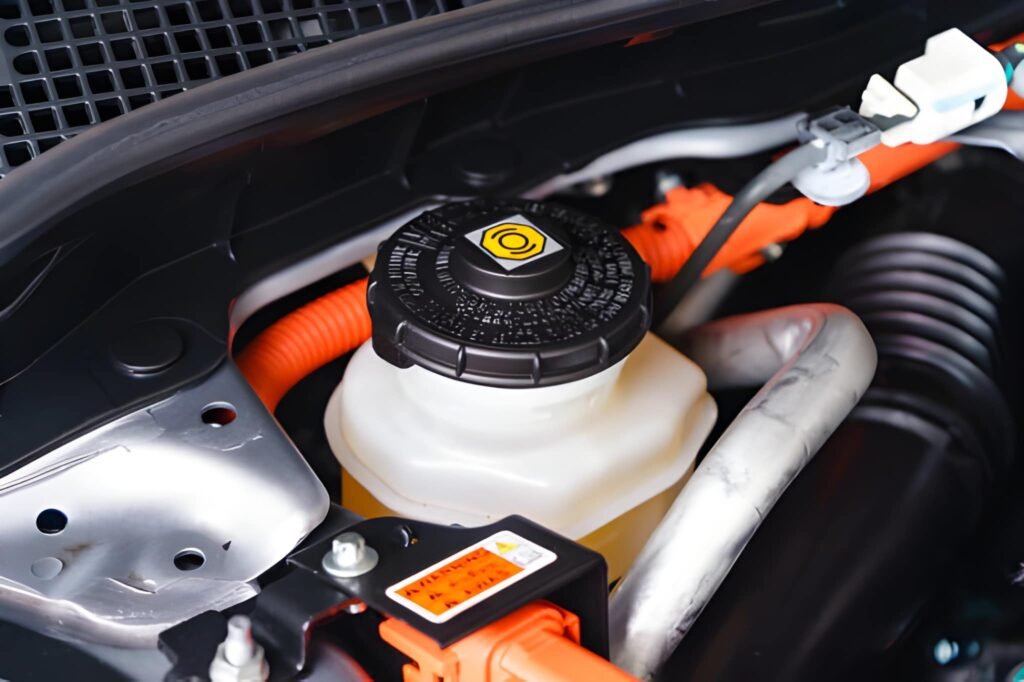
You should keep track of the fluid levels and make sure it is at the MIN and MAX levels located on the side of the reservoir. If the fluid is less than the MIN, you will want to add more fluid.
That said, if you are continually topping off the fluid, there may be an issue with your braking system, like a leak. If that’s the case, it’s important to have the system checked by a professional.
3. Full Brake Fluid Change
Changing your brake fluid completely will need at least 1 liter of brake fluid. This is an estimate since the amount you will need will depend on the size of your braking system. The process contains replacing the fluid with fresh fluid after completely draining the system of any old fluid. If your car has a big braking system, you may need to increase your estimate a little.
Types of Brake Fluid and Their Capacities
Different brake fluids are tailored to individual driving situations and vehicle specs. Recognizing what’s best and knowing the precise quantities to maintain them plays an important role in the efficiency and safety of the braking system.
1. DOT 3 Brake Fluid
A glycol-based fluid that stands as one of the more popular choices for everyday passenger cars is The DOT 3. It’s moisture absorbing phenomena lowers its effectiveness. This braking fluid is widely used in compact cars and older model vehicles. Most cars operated in standard driving circumstances utilize DOT 3.
Required Amount: Most vehicles utilizing DOT 3 require between 500ml – 1 liter for a total fluid change.
2. DOT 4 Brake Fluid
The higher category trucks and vehicles, as well as performance based cars utilize DOT 4. It is one of the more common fluids used for such driving applications. Compared to the DOT 3, DOT 4 exhibits a stronger resistance to moisture and an increased boiling point, making it applicable for higher exerted braking torques.
Required Amount: A total fluid change for DOT 4 range between 750ml – 1 liter.
3. DOT 5 Brake Fluid
This type of fluid does not absorb moisture. This makes DOT 5 great for vehicles driven in humid, rainy, or wet conditions. DOT 5 does not mix well with other brake fluids like 3, 4, or 5.1, which makes switching brake fluids in vehicles using DOT 5 impossible.
Required Amount: Changing DOT 5 brake fluids regularly requires approximately 1 liter.
4. DOT 5.1 Brake Fluid
This type of brake fluid is similar to DOT 4 brake fluid with a higher boiling point. DOT 5.1 is also different as it is a glycol-based fluid. Unlike other DOT 5 fluids, it is also very great for low and high temperatures. This brake fluid is used in high-performance vehicles and engineering trucks.
Required Amount: Flush out completely and add 1 liter of DOT 5.1 to your vehicle. This is the same for DOT 4 Racing Brake Fluid.
How to Check and Top Up Brake Fluid
Checking your brake fluid and maintaining them is simple, but it is also very important for the braking system in your vehicle to work properly.
1. Find the Brake Fluid Reservoir: You will find the brake fluid reservoir at the back of the engine bay. It is a small container that is either transparent and can be screwed open, or have a cap that snaps shut. You can find the min and max fluid level markings on the sides of the reservoir.
2. Inspect Fluid Levels: You will need to check the fluid levels by:
- Parking on level ground.
- Opening the engine bay and looking at the fluid reservoir.
- Inspect the sides of the reservoir to check the fluid level
If the level is below the min, then you need to refill the brake fluid reservoir.
Check the fluid color. Fresh brake fluid is either clear, or amber. If you notice that the fluid is dark and murky, that might indicate that the fluid is contaminated, and you need to replace it.
3. Refilling Brake Fluid: In order to refill the fluid, follow these steps:
Remove the reservoir cap slowly to prevent contaminants from getting inside.
Add the brake fluid that is specified in your vehicle’s manual. The approved fluids might be DOT 3, DOT 4 or DOT 5.
After adding fluid, securely close the cap to keep moisture out.
Frequently Asked Question
Here are some FAQs about amount of brake fluid –
- How often should I check my brake fluid level?
It is advisable to check brake fluid levels every couple of months and before long journeys.
- Can I use any brake fluid in my car?
No, each car is designed to use a specific type of brake fluid. Using the wrong brake fluid will damage the brake system.
- What can happen if you put too much brake fluid in the reservoir?
If you put too much brake fluid in the reservoir, the overflow can damage the seals, hoses, and/or paint on the car.
- What are the signs that brake fluid needs to be replaced?
Some signs that indicate a need for fluid replacement are a soft brake pedal, decreased braking ability, and/or the brake fluid is dirty. If any of these are present, then replacement is needed.
- Is it possible to replace brake fluid on your own?
Replacing brake fluid can be done on your own if the right tools and expertise are available. If the process is not known, then it is better to let a professional do it.
Conclusion
When thinking about the safety and effectiveness of your brake system, knowing how much brake fluid is needed and the right time to replace them is important. Remember to check brake fluid levels, replace the fluid at the necessary schedules, and maintain the proper brake system fluid levels. After doing all of these, the brake system will be able to perform optimally, and remove the risk of dangerous situations.
It is important to use the correct brake fluid type. Some brake fluid types are not compatible, and the wrong type can lead to further problems. Contaminated brake fluid may compromise the system as well.