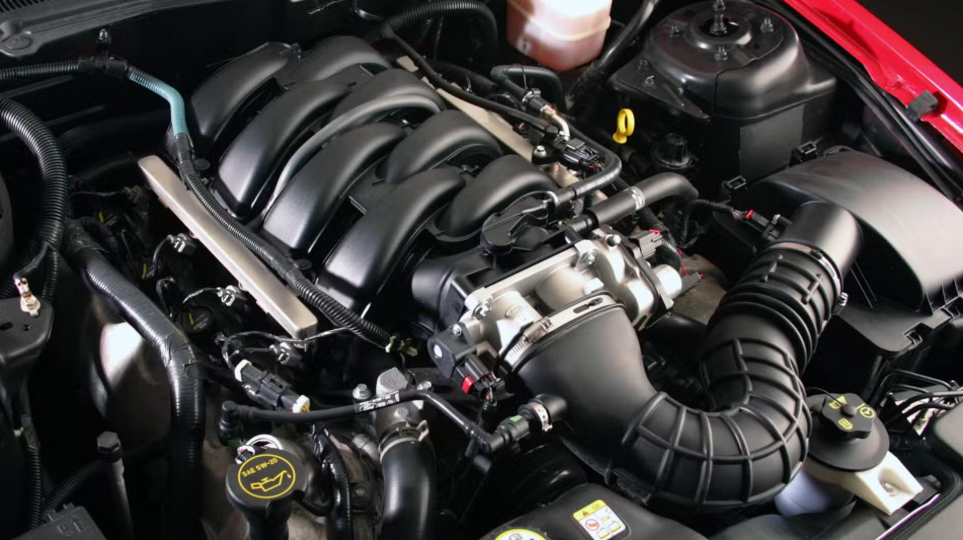
What is a V8 engine? A V8 engine is an internal combustion engine with eight cylinders arranged in a “V” configuration. Known for its power and performance, it’s commonly used in sports cars, trucks, and SUVs to provide strong acceleration and towing capabilities.
The automotive industry’s rising demand for an engine that offers superior performance, seamless driving experience, and propels the vehicle at a greater speed led to the creation of massive 8 cylinder engines known as V8 engines. V8 engines are designed for high performance as well as for the towing of large loads, and even for off road activities that require rugged driving. The V8 is configured such that the eight cylinders of the engine are arranged in a ‘V’ formation giving it the unique ability to outperform all other engine configurations available in the market.
There are a multitude of varying tasks, and even high speed driving, that V8 engines are able to perform in vehicles ranging from luxury vehicles to sporty muscle vehicles to tough service trucks. There are a multitude of tasks, high speed driving, towing and traversing off road that V8 engines are able to perform. The purpose of the following article is to explore and analyze the reasons V8 engines are so popular.
Contents
- 1 Why are V8 Engines so Popular?
- 2 The Engine Structure
- 3 Key Features of a V8 Engine
- 4 Why V8 Engines are a Popular Choice for Cars, Trucks, and SUVs
- 5 V8 Engines Compared to Other Engines
- 6 Applications of V8 Engines
- 7 How V8 Engines Work
- 8 V8 Engine Pros and Cons
- 9 Frequently Asked Questions
- 10 Conclusion
Why are V8 Engines so Popular?
The V8 engine is a type of engine that contains a total of eight cylinders in its structure. The cylinders are arranged such that there are two ‘banks’ of four cylinders and these banks are positioned at a slant angle to each other to form a ‘V’ shape, thus completing the ‘V8’ designation. The structure and configuration of a V8 engine offers an even and equal distribution of power as well as a high level of engine smoothness and performance that other engines are not able to provide. The V8 configuration is a standard engine in performance vehicles having its first introduction in vehicles of high performance in the early 1900s.
V8 engines are better than other engines due to their powerful design, high power generation, and versatility. In this section we explain how they achieve this with their structure and how it works.
The Engine Structure
The structure of a V8 engine is what makes them uniquely popular. Their configuration, components, and how they work together, helps create powerful and smooth performance. Let’s explore these characteristics.
Cylinder Configuration
The V8 engine cylinders are arranged in two banks of four and set at a 90-degree angle from each other. This arrangement helps to maintain a high power-to-weight ratio. V8 engine has two rows of four cylinders.
The arrangement of these design patterns helps with the engine running smooth. Balanced arrangements reduces vibration and helps the engine run smooth. Unlike inline engines, V8 engines are more prone to vibration, making in run more smooth.
Crankshaft
The crankshaft is essential as it changes the linear motion of the pistons into rotational motion. It is connected to all pistons, and as each piston moves up and down, the crankshaft rotates, powering the wheels of the car.
Compared to smaller engines, the crankshaft of a V8 engine has much more strength. This is important as it allows the crankshaft to endure the high levels of power and torque associated with the much larger displacement of a V8 engine.
Pistons
The V8 engine has one piston per cylinder, and therefore has 8 pistons. The pistons drive the crankshaft and move as a result of the combustion of air and fuel. The pistons are designed to move in a specific way in order to enhance the overall performance of the engine.
Pistons in the engine cylinders move in a vertical direction, and this vertical motion is driven by the combustion of fuel in the cylinders. The pistons generate the power needed to propel the car.
Valves and Camshaft
A V8 engine’s valves and camshaft regulate the volume and timing of intake and exhaust requests. A cylindrical unit’s valves manage gaseous requests and facilitate the entry of the Air-Fuel mixture. Each unit’s valves and camshaft provide operational timing. Camshafts extend, rotate, and control valves, facilitating the engine’s ability to control operational timing and volume efficiently.
Key Features of a V8 Engine
V8 engines feature unique attributes that provide the engine with power, stability, and consistent functionality. We will examine these attributes to provide a clear description of the engine’s construction, advantages, and distinct operational capabilities.
Outstanding Power and Performance: The V8 engine’s ability to produce power and torque is unparalleled. This characteristic makes it the ideal engine for sports cars, luxury sedans, and trucks and SUVs that need power for acceleration and towing.
Smooth operation: A V8 engine’s design results in higher precision mechanics than in a typical engine, giving lower vibrations, and a feeling of smooth operation, refinement, and quiet efficiency compared to four-cylinder engines.
Greater Torque: Compared to smaller engines, V8 engines create greater torque, which is a force that accelerates the rotation of the crankshaft, allowing for a higher rate of acceleration, greater towing capabilities, and improved overall performance.
High Versatility: The V8 engine can be fitted in a lot of vehicles, including high performance sports cars, rugged trucks, and heavy duty SUVs. They’re able to handle highly demanding power loads while maintaining efficiency and therefore are highly suited for performance and work vehicles.
Why V8 Engines are a Popular Choice for Cars, Trucks, and SUVs
With regards to power, reliability, and overall performance, choosing a V8 engine for a performance car, truck, or SUV offers huge benefits. In this section, we’ll identify the advantages of this engine choice in further detail.
1. Highest Performance
V8 engines are some of the most powerful engines on the market today. With 8 different cylinders working together, engines are able to generate an incredible amount of horsepower and torque. This raw power is what allows sports and luxury cars to achieve high acceleration and high top speeds.
The power of the V8 engine is extremely useful when it comes to towing and transporting heavy loads. Because of the engine’s higher displacement, it gives off a greater amount of torque, which is so important when it comes to towing trailers and transporting heavy equipment.
2. Smooth, Quiet, and Refined Driving Experiences
The configuration of the V8 blocks allows the engine to have a much smoother operation than that of the inline engines. The V8 engines also are randomly quieter and are less likely to induce vibrations. This makes driving it feel even more refined. This is the reason a lot of luxury sedans and high-end cars utilize V8 engines.
3. Built to Last
V8 engines are able to be more durable in comparison to smaller engines. Because of their higher displacement and more robust design, the engines are also built to be able to withstand a greater amount of stress for a longer period of time. This is the primary reason V8 engines are typically used for vehicles that will typically be used for heavy duty purposes, such as trucks and SUVs.
High-performance vehicles need engines that are high-performing and reliable over time. As long as there are regular maintenance checks, V8 engines will last for several hundred thousand miles.
4. More Towing Power
V8 engines are one of the best engines for larger vehicles and trucks, because of their towing and hauling power. V8 engines generate considerable torque and can effortlessly pull and tow large loads, including boats and trailers. This is highly important for truck owners who intend to use their vehicles for towing.
5. Improved Driving Experience
V8 engines will provide a driving experience like no other. Their power and almost instantaneous response to acceleration allows for a great deal of acceleration and a high level of responsiveness. This is why vehicles with V8 engines are highly desirable, especially to enthusiasts.
V8 Engines Compared to Other Engines
Let’s look at some other common engine configurations and determine how different they are from the V8, the advantages, and how the V8 stands out.
V6 Engines
A V6 engine, which is V shaped and consists of six cylinders in two banks of three cylinders, is capable of decent performance and power, but is usually less powerful than the V8 engine by a wide margin. Because of their ability to produce more horsepower and torque, V8 engines are more advantageous in cases involving heavy-duty vehicles and the sporting and performance-oriented models.
But when it comes down to the effectiveness of the engine, they are usually less fuel efficient than the V6 engines. Therefore, V6 engines would be a more sensible option for those who would rather prioritize fuel efficiency.
Inline Four Engines
Inline-four engines are the most common type of engine found in small fuel-efficient vehicles. Inline-four engines consist of a single row of four cylinders and are less powerful in their construction than V8 engines, which is why they give a lot less in the form of horsepower and torque. Because their engine performance is far less, they produce a lot more fuel efficiency. Their power output is far less along the performance spectrum.
Because fuel efficiency is more of a priority than performance, inline-four engines are well suited to small cars, sedans and hatchbacks.
Inline Six Engines
Inline-six engines are a potential substitute of V8 engines. They consist of six cylinders all arranged to be in a straight line which makes them known for their smoothness and balance. While Inline-six engines have a more refined driving experience, they usually have a lower output of horsepower and torque compared to V8 engines. It is important to note, however, that they tend to be more fuel efficient than V8 engines.
Applications of V8 Engines
V8 engines are incorporated into a variety of vehicles including sports cars, luxury sedans, and trucks, and SUVs. Here are some examples of use in particular segments:
Sports Cars: V8 engines also provide exhilarating performance in the Ford Mustang GT, Dodge Charger, and Chevrolet Camaro.
Luxury Sedans: V8 engines enhance the power, refinement, and luxury in the top class sedans of Mercedes-Benz, BMW, and Audi.
Trucks and SUVs: V8 engines are a great addition in the Ford F-150, RAM 1500, and Chevrolet Silverado truck series as they provide better towing and payload capacity.
How V8 Engines Work
V8 engines, like all engines, stem from the same internal combustion principles, but are differentiated by the arrangements of the engine cylinders. Here’s how a typical V8 engine cycle works step by step:
- Intake Stroke: The piston moves downward, and the intake valve opens to create a vacuum that pulls an air-fuel mixture into the combustion chamber.
- Compression Stroke: The piston moves upward and compresses the air-fuel mixture.
- Power Stroke: An explosion occurs after a spark plug ignites the compressed mixture. The explosion is the driving force that moves the piston downward.
- Exhaust Stroke: The exhaust valve opens, and the piston moves upward to push out the exhaust gases.
This cycle occurs in each of the eight cylinders of the engine providing the vehicle with a consistent flow of power.
V8 Engine Pros and Cons
There are positives and negatives in all engine types, and we will delve into the pros and cons of V8 engines so that you can make a more informed decision about your vehicle requirements.
Pros of a V8 Engine
- Smooth Operation: The V8 engine is built to run with fewer vibrations, allowing for a refined driving experience.
- Durability: V8 engines are built to last, allowing for high mileage engines to be run for a long period of time.
- Towing Capacity: Due to its engine design, a higher torque level is created giving a V8 engine the ability to tow larger items.
Cons of a V8 Engine
- Fuel Efficiency: Due to the construction, V8 engines will use more gas than that of a more traditional engine, therefore costing more to run.
- Size & Weight: V8 engines are much larger and pack more weight than that of a traditional engine causing a vehicle to be less agile.
- Cost: Due to the construction of the engine, V8 engines cost are more to produce than that of a traditional engine.
Related Article
What Is a Spoon Engine?
What Is a Lifter in an Engine?
What Does a Naturally Aspirated Engine Mean?
Frequently Asked Questions
Here are some FAQs about V8 engines –
- What is the difference between a V8 and V6 engine?
A V8 engine is more powerful than that of a V6 as the V8 engine has more than two banks of pistons, allowing it to produce larger power. But a V6 engine compromises power for more control over gas usage.
- Are V8 engines more fuel-efficient than other engines?
A V8 engine will use more gas than that of a naturally aspirated engine. Even though they are more powerful than most other engines, the larger size and more power requirement will create a low gas mileage.
- What are V8 engines best for?
For powerful acceleration, towing capacity, and overall performance, V8 engines are best for performance vehicles and SUVs like trucks.
- What’s the average lifespan of a V8 engine?
With maintenance, a V8 engine can last more than 200,000 miles.
- Why are some vehicles equipped with V8 engines instead of smaller engines?
V8 engines are made for heavy-duty for more power, smooth operation, and better towing.
Conclusion
V8 engines are powerful, perform, and are smooth, and are made for all kinds of vehicles and applications. There are sports, luxury, and v-class trucks, and large tractor trucks, and any other vehicles with very high power and torque needs. V8 engines may not match smaller engines for fuel economy but are chosen for performance, durability, and versatility. An unrivalled experience is what the V8 engine provides either in a muscle vehicle or in a heavy-class truck.