


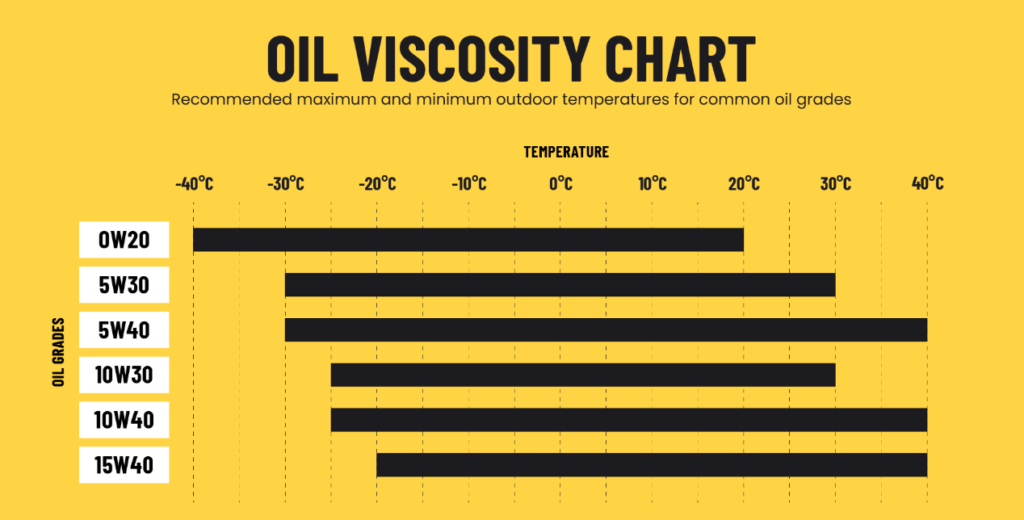
Engine oil grades chart shows the viscosity of oils at different temperatures. It helps you choose the right oil for your vehicle’s performance and climate conditions.
To ensure the well being of any engine, it is important to understand the grades of engine oils. Whether it is a car, or a truck, or a motorcycle or any other engine driven vehicle, one of the most important things to make sure that you run your engine smoothly is knowing what type of engine oil grade you should be using. The engine oil grades chart classifies oil into various types according to the viscosity, resistance to temperature and performance. The misuse of oil in your engine may result in low fuel economy, unnecessary wear and tear as well as permanent damage to your engine.
This article will go into details about the engine oil grades chart, its meaning and will assist you in knowing how to select the best oil to use in your car.


Contents
- 1 What Are Engine Oil Grades?
- 2 The Determination of Engine Oil Grades
- 3 SAE Engine Oil Grades Chart Breakdown
- 4 What Does Every Grade of Engine Oil Have?
- 5 Selecting the Right Engine oil Depending on the Weather Condition
- 6 The Guide to Choosing the Correct Oil in your Engine
- 7 The Advantages of Selecting the Appropriate Engine Oil
- 8 Popular Misconceptions of Engine Oil Grades
- 9 Frequently Asked Questions
- 10 Conclusion
What Are Engine Oil Grades?
A classification system of engine oil is known as engine oil grades and is used to identify the level of performance and viscosity of engine oil. Oil viscosity is the thickness of the oil and its flowing capacity, in particular, at various temperatures. To put it in simpler words, engine oil grades provide us with an idea of the thickness or thinness of the oil, the performance of the oil at low and high temperatures.
The SAE (Society of Automotive Engineers) and the API (American Petroleum Institute) are the most widely used engine oil grades. These two organizations offer standardized approaches of labelling and classifying engine oils according to their properties.
Engine oil grades have two major components:
- Viscosity: This is the resisting properties of the oil to flow. Thicker oils are not efficiency but offer more protection when the temperature is high and are not efficient in low temperatures. Conversely, the low viscosity oils are less viscous and are easy to flow at low temperatures.
- Performance Level: This is the capacity of the oil to resist stress, corrosion resistance and wear resistance. It is also a measure of the smoothness of the running of the engine with the help of the oil.
The Determination of Engine Oil Grades
To simplify matters, we may divide the process of engine oils classification and grading. The most popular system of classification is a number-letter combination. For example, 5W-30 or 10W-40.
Viscosity Rating (e.g., 5W-30):
- The first figure, preceding the “W” shows the viscosity of the oil at low temperatures (Winter). The smaller the number, the less the oil in cold conditions, and therefore, cold starts. An example of this is that 5W is lighter than 10W hence 5W oil works better in colder weather.
- The figure following the W indicates the performance of the oil at higher temperatures (100 deg C). The more the better the oil will be thick at high temperatures. An illustration is that 30 is thinner than 40, i.e. a 5W-30 oil will flow more at higher temperatures than a 5W-40 oil.
Performance Ratings (e.g., API SN, API SM):
- The API ratings are written in the form of S and C in which S is gasoline engine oils and C diesel engine oils.
- The S or C that is added to the letters indicate the level of performance of the oil (SN or SM). SN oils have the most recent technology and performance. The further the letter series advances the better it becomes in regards to performance, protection, and environmental advantages.
SAE Engine Oil Grades Chart Breakdown
To have a closer look at how to read the engine oil grades chart and understand the differences of various types of oils, we should take a closer look at how we could read the engine oil grades chart.
| Oil Grade | Winter Viscosity (Low Temp) | High Temp Viscosity | Ideal Usage | Recommended For |
|---|---|---|---|---|
| 0W-20 | 0 | 20 | Cold climates, high fuel efficiency | Fuel efficiency, cold start protection |
| 5W-20 | 5 | 20 | Cold climates, improved fuel efficiency | Fuel efficiency, moderate temperatures |
| 5W-30 | 5 | 30 | Common for modern engines in moderate climates | General use, moderate temperatures |
| 10W-30 | 10 | 30 | Moderate temperatures, fuel-efficient | Moderate temperatures, standard engines |
| 10W-40 | 10 | 40 | Hot climates, higher protection against engine wear | Heavy-duty engines, high heat conditions |
| 15W-40 | 15 | 40 | Hot climates, heavy-duty engines, trucks | Heavy-duty engines, commercial vehicles |
| 20W-50 | 20 | 50 | Older engines, high-temperature conditions, high performance | Older engines, performance engines |
Single-Grade Oils: These oils are referred to as SAE 30 or SAE 40. They are meant to be used in stationary temperature conditions which mostly apply to older engines that do not require the versatility of multi-grade oils. Oils in single grade are no longer as widespread, and often appear in older automobiles or machinery.
Multi-Grade Oils: Three numbers are used to indicate these oils i.e., 5W-30, 10W-40 or 15W-40. The number before the W stands to show the performance of the oil in cold temperatures (Winter) whereas the number after the W stands to show the performance of the oil in high temperatures.
Multi-grade oil is usually employed as it provides flexibility during both hot and cold seasons. These oils are more protective at a large spectrum of temperatures.
Synthetic and conventional oils: Traditional oils are produced with the help of crude oil and they possess a narrow temperature scope.
Synthetic oils are chemically modified to provide high performance and protection particularly in high temperature. They are more resistant than conventional oils and they are durable.
What Does Every Grade of Engine Oil Have?
We shall separate out the engine oil grades:
0W-20 and 5W-20: These oils are made to suit the modern engines which demand low viscosity so that they can have better fuel economy and run efficiently in cold weather. 0W-20 is also good in terms of fuel economy in engines that do not need a heavy-duty oil.
5W-30 and 10W-30: These are the current widely used car oils. They provide moderate cold-start protection with high-temperature stability and 5W-30 is suitable in moderate to cold climates, and 10W-30 is suitable in slightly warmer climates.
10W-40 and 15W-40: Those oils are also heavier and provide greater high temperature protection. They can be used in older engines or engines that experience heavy loads and high temperatures like trucks or performance cars.
20W-50: This oil is mostly applicable in older high performance or racing engines. The viscous oil offers extra safety to engines that are used in severe environments like driving at high temperatures or in high-speed schemes.
Selecting the Right Engine oil Depending on the Weather Condition
The climate that you drive in is also a significant factor that defines the type of engine oil grade that is most appropriate to your car.
Cold Climates: In lower temperatures, you will want an oil, which flows freely in low temperatures to make sure the engine starts without straining, 5W-30 or 0W-20 would be best in cold weather, as it is thinner at low temperatures.
Hot Climates: In warmer climates, the oil must have the capability of sustaining its viscosity at high temperatures without disintegrating. These conditions would require a 10W-40 or 15W-50 oil since it provides an oil protection that is thicker at higher temperature.
The Guide to Choosing the Correct Oil in your Engine
Although the engine oil grades chart may be an effective guide, the most effective method of selecting the oil to use in your engine is to use the recommendations of its manufacturer. Always consult the vehicle owner manual on the type of oil grade he or she recommends to use in your engine. Such aspects as the type of engine, the conditions in which the vehicle is going to be used, and the preferences of the manufacturers are very important in this decision.
The following are some of the tips in selecting the right oil:
- See the Owner Manual: You should always consult your vehicle owner manual and get the recommended grade and specification of oil used as recommended by the manufacturer.
- Think about Your Driving Situation: Do you often drive in extreme temperature, in heavy traffic, or carry heavy loads? In that case, it is better to select a higher viscosity rating oil.
- Select the Type of Oil: Select regular or synthetic oil. Synthetic oils are also better in performance particularly in new vehicles and conventional oils are applicable in old-fashioned models.
- Select Multi-Grade Oils to be Multi-purpose: Multi-grade oils such as 5W-30 or 10W-40 are a safe way to go most of the modern cars, as it provides adaptability in different weather and situations.
The Advantages of Selecting the Appropriate Engine Oil
The choice of the right engine oil grade is necessary because of the following reasons:
- Better Engine Performance: With proper lubrication, the engine operates smoothly and the friction and wear are minimized.
- Fuel Efficiency: With the help of the right oil, fuel efficiency can be increased because the friction is reduced and the engine can be made more efficient.
- Long Engine Life: Frequent use of recommended oil will ensure the engine does not rust, corrode and other damages, thus increasing the life of the engine.
- Cold Start Protection: Oils that are lower in viscosity such as 0W-20, will start the engine easier in cold climates and will place less stress on the engine.
Popular Misconceptions of Engine Oil Grades
The engine oil grades have some misunderstandings that may confuse:
- Thicker Oil is Better: Not always. Oils with a higher viscosity do not necessarily give superior protection. Viscosity must be taken according to the specifications of the manufacturer and the conditions under which the vehicle is going to run.
- More Expensive Oils Are Always Better: Although synthetic oils are the best performing, they are not always required in every car. Always take the advice of the manufacturer of the vehicle.
Related Article
Engine Oil Capacity Chart for All Vehicles
Engine Oil Color Chart
Engine Oil Filter Cross Reference Chart
Frequently Asked Questions
here are some FAQs about engine oil grades chart –
1. What is the number before the W in engine oil?
The digits preceding the W show the viscosity of oil in low temperatures. The smaller the number, the higher the performance in cold weather.
2. Can I use 10W-30 oil instead of 5W-30 oil?
Although both are multi-grade oils it is best to use the oil grade as prescribed by your car manufacturer. When the weather is cold, it may cause strain in the engine when a higher viscosity oil is used.
3. What is better than conventional oil? Synthetic oil.
Synthetic oil is chemically designed to provide superior protection at high temperatures and increases the period between changes of oil. It is perfect in newer engines and high-performance vehicles.
4. How many times do you change engine oil?
It is recommended that oil be replaced after every 3,000 to 5,000 miles, though, of course, always consult the manufacturer as to the exact time.
5. Is it possible to use the same grade of oil in other cars?
The oil grade that is recommended by the manufacturer must be used on each vehicle. These engines need varies needs based on the design, age and performance needs.
Conclusion
Engine oil grades chart is a handy tool in understanding of the many types of oil and the correct one to use in your engine. It does not matter if it is extreme weather, high performance engines, or the everyday driving conditions, the right oil choice means that the engine will be kept safe and will be able to work efficiently. The owner manual of your vehicle always comes first and then you have to look at the environmental factors before choosing the oil. When you use the right grade of oil, you are guaranteed of a smooth running engine, a long lasting engine, and an engine that runs at its optimum.


