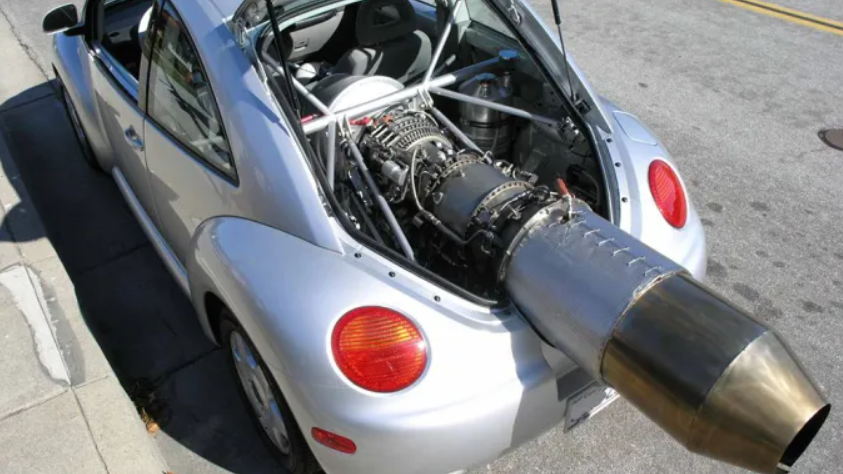
A jet engine on car uses thrust for extreme speed, surpassing 700 mph. However, it comes with challenges like high fuel consumption and control issues at low speeds.
The jet engine on car concept has a long history, involving a lot of engineering ingenuity along with a passion for speed. Jet engines, which are primarily relied upon by airplanes for thrust, have been used in different ways for some high-performance ground vehicles. These vehicles are largely designed for speed and for pushing the boundaries of engineering. Although jet engines can provide an extreme amount of thrust, there are many difficulties in applying them in road vehicles due to fuel usage, control over extreme speeds, and overall practical use.
This article focuses on the history, mechanics, and issues concerning the use of jet engines on road vehicles, examining notable examples and the high-performance vehicles of the future.
Contents
What is a Jet Engine and How Does It Work on a Car?
A vehicle equipped with an engine that is able to produce thrust by forcing out high-speed exhaust is different from a car engine that incorporates combustion to create rotational kinetic energy. Jet engines are not built to create rotation, but instead create to flow exhaust to rapidly propel the vehicle.
Basic Function of a Jet Engine
A jet engine works by taking in air and compressing it. Then it mixes the air with fuel and ignites the combustive materials. Finally the jet engine releases the resulting combustive materials by-products. This high-pressure exhaust is what gives the jet engine its propulsion. The main stages in a jet engine include:
- Compression Stage – Engine air is pulled in and compressed to high pressure with a set of rotating blades known as the compressor.
- Combustion Stage – The pressed air is then injected with fuel to be combusted in the combustion chamber to form hot combustion gases.
- Turbine Stage – The hot gases travel through a turbine. Turbines extract energy in order to run the compressor and other jet engine components.
- Exhaust Stage – The fast-exiting exhaust gases are released through the combustion chamber and produce thrust that pulls the engine forward.
How is a Jet Engine Different From a Standard Car Engine?
Jet engines are different as standard car engines are piston based. Jet engines push gas to get propulsion while internal combustion engines drive wheels through gas combustion. There is a difference in functionality as standard car engines are designed to seamlessly transfer power while jet engines are designed to optimize thrust at high speeds and therefore gas combustion.
The History of Jet Engines on Cars
The history of jet engines on cars depends on attempts to break the land speed record. Using jet engines to break speed records has always fascinated engineers and speed enthusiasts. Cars powered by jets began to be built in the middle of the 20th century and quickly gained the interest of the public.
First Jet-Powered Cars
Most of the first cars with jet engines were built in the attempt to break the land speed record. Jet propulsion was the most logical answer to the question of how to break record speeds. The first successful tests were done using surplus jet engines from military aircraft.
- Spirit of America: Craig Breedlove’s Spirit of America was one of the first examples that incorporated a jet engine into a car. The car featured a General Electric J47 jet engine that produced over 10,000 pounds of thrust. In 1963, Breedlove broke the world land speed record going over 400 mph (640 km/h). The Spirit of America was one of the first of its kind and broke new ground in the jet-powered vehicle industry.
- Green Monster: In the 1960s, Art Arfons built a jet-powered car called the Green Monster. It featured a Westinghouse J34 turbojet engine which produced considerable thrust. While the Spirit of America is still the fastest, the Green Monster was still a good demonstration of the potential of jet propulsion of land vehicles. It managed to reach speeds of over 600 mph (960 km/h) during its attempts.
ThrustSSC
The Land Speed Record Holder 1997 was the first year in history where a vehicle was able to break the sound barrier on land, and that vehicle was the ThrustSSC. The vehicle was powered by 2 Rolls-Royce Spey turbojet engines which allowed the ThrustSSC to reach a speed of 763 mph (1,228 km/h). With this speed, the ThrustSSC officially became the first vehicle to break the sound barrier on land.
The ThrustSSC was made with remarkable precision. ThrustSSC was the first jet car to pay particular attention to aerodynamics, stability, and control at supersonic speeds. The car was piloted by Andy Green, a British pilot and engineer. The feat cemented the idea of having jet engines on cars as justifiable, and not merely a fantasy.
Notable Examples of Jet-Powered Cars
Aside from the notable example of ThrustSSC, there have been other examples of jet engine cars:
- FireForce 5: This jet-powered dragster was built by Chris Loder, and it uses a Pratt & Whitney JT12 turbojet engine, generating almost 10 000 hp. It is one of the fastest drag cars in the world as it can reach 200 mph (320 km/h) in a few seconds.
- EcoJet: This is a high-performance concept vehicle designed by Jay Leno. It was powered by a Honeywell GT502 turbine engine, exemplifying jet engine technology integrated in a more sustainable and futuristic way. Although the EcoJet was able to go over 200 mph (320 km/h), the key focus was on design and the exploration of a hybrid jet propulsion.
Benefits of Jet Engines in Vehicles
When it comes to high-performance vehicles, there is a wide variety of benefits that jet engines provide in terms of acceleration and power.
1. Peerless Speed
The most notable benefit of a jet engine on car is its exceptional speed potential. Jet engines are purposely designed to run effectively at very high speeds, thus allowing jet-powered vehicles to achieve speeds beyond the limits of any internal combustion engine.
2. Fast Acceleration
Jet engines can do fast acceleration which is useful in racing or speed trials. A jet engine can do full power thrust to allow a car to reach over its top speed quickly than normal combustion engines.
3. High Thrust-to-Weight Ratio
Jet engines can have high Thrust-to-Weight ratios so they can create a copiousamount of relative power to their size. This makes jet powered vehicles more superior than normal cars.
4. High Speed Aerodynamic Efficiency
Jet engines are built for high speeds. When used on land speed record cars, they allow for high speed efficient operation. Turbines can work more efficiently than other engines at high speeds.
Problems of Jet Engines on Cars
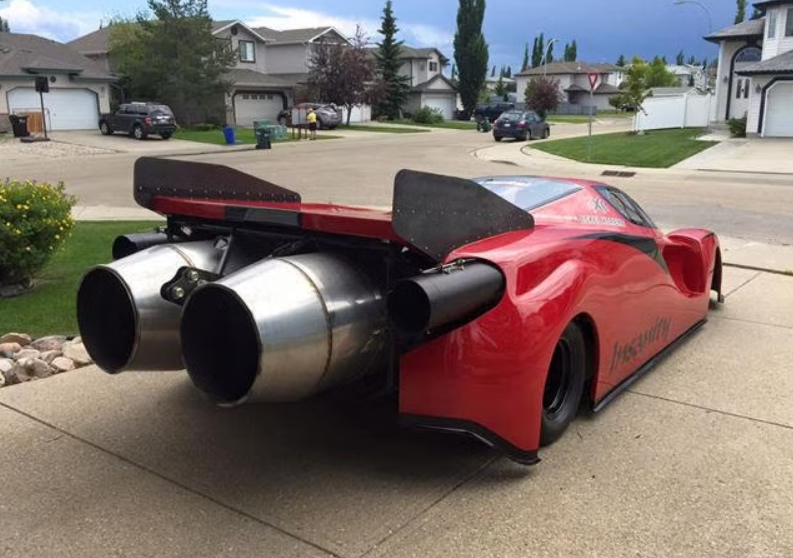
Jet engines on cars could have high speed potential. There are many issues with jet engines on cars and these issues include practical limitations, fuel consumption, and control issues.
1. Inefficient fuel consumption
Due to the engine type used in these cars, one huge downside of the jet cars is fuel consumption. Jet-powered cars will burn a lot more fuel when they are accelerating to higher speeds than ordinary cars will. That type of engine is mainly used in aircraft, as they need a lot of fuel to be consumed in order to be effective when propelled to high speeds. Because of that, jet-powered cars are not practical for a day to day driving or long distance traveling.
2. Control and Stability
It’s extremely difficult to maintain control and stability of a jet engine car. When a jet engine is installed in a car, it generates enormous amounts of power and that is the opposite of a standard car engine. The stability of jet-powered cars is very important and for that to be the case, a great amount of technology has to be used in the construction of that jet-powered car, such as able in order to ensure the proper amounts of suspension control, and proper amounts of aerodynamics.
3. Heat Generation
Jet motors produce a lot of heat and this heat can impact the vehicle in a very positive way or a very negative way. Jet-powered cars will have serious mechanical issues unless they are fitted with some advanced and sometimes sophisticated heat control systems. The more extreme the design is on the heat systems, the more reliable and efficient the jet-powered cars will be.
4. High Costs
Building a jet powered car requires a substantial investment. The engines alone are expensive, and high-performance vehicles have high upkeep costs. In addition, jet engines are beyond the reach of most car manufacturers or enthusiasts because they come with specialized parts and knowledge requirements.
The Future of Jet Engines on Cars
While the technology of jet engines on cars will never replace standard car engines, it will always have a position in racing and concept cars. Jet engine technology is improving. For example, hybrid propulsion systems integrate standard engines with jet engines, which is a game changer for jet powered cars.
Investing in fuel and cooling systems while improving the aerodynamics of the vehicle will allow us to harness jet engine technology for the creation of new vehicles for everyday use. Jet propulsion is great for high speeds, but is not efficient on its own. Thus, combining it with other power sources gives us the best of both worlds.
Frequently Asked Questions
Here are some FAQs about jet engines on cars –
1. How fast can a jet powered car go?
Jet powered cars exceed speeds of 700 mph, with the ThrustSSC breaking the sound barrier at a whopping 763 mph.
2. Why aren’t people using cars with jet engines for driving?
Jet engines are dangerous at lower speeds. They’re also very fuel inefficient, and therefore, aren’t practical for use in driving.
3. Are jet cars allowed in racing?
Of course, jet cars are allowed in racing. They’re particularly favored in drag racing, and in attempts to set land speed records, where maximum acceleration and speed are most desirable.
4. What are the issues with jet engines being in cars?
Most issues stem from a lack of fuel efficiency, high operational cost, control issues at high speeds, and the production of extreme amounts of heat.
5. Is it possible for me to make a jet car?
Most people’s capabilities don’t come close to making a jet car. It takes a lot of advanced engineering, specialized parts, and, most of all, resources, to do.
Conclusion
The idea of putting a jet engine in a car still captivates engineers and people who enjoy speed. Even though it is not practical, sending a gas powered car down a track is fuel and cost inefficient as well as difficult to control. They mainly demonstrate what is possible in the automotive world. As technology improves, we may start to see jet engines coupled to regular combustion engines (hybrid solutions). Jet cars will always be breaking land speed records, and show us what is possible in automotive design.